I begun playing Octopath Traveler — a rather clunky and unattractive title — the Saturday after it came out. I chose H’aanit and I played through her first chapter. I regretted it immensely. I could not stand her speech nor the voice acting; I thought it was an awful amalgamation of Old English, Middle English, and Early Modern English. As soon as I could, I changed the voices to Japanese which made it better. While interesting and cliche*, nothing about her story was compelling. Nothing about the game was compelling, at least so far. I felt bored going through the motions. Then, I went to Therion’s town and played his chapter. The end to his Chapter 1 was particularly interesting; it had a nice twist that left me wanting to know more. But, because of the steep level gate, I was not particularly compelled to continue the story. Being around level 6 (and taking two hours to get to that level) and seeing a “Recommended Level: 24” sign on the next part of the story was a particular turn off.
And then I got into the groove of the game. Something clicked. After unlocking all the characters and then each job system, the game unlocked. The combat became intensely fun and — strangely enough for a turn-based game — incredibly active. Savescumming for high-level gear also wasn’t bad. Five chances to get a golden axe, for example, was not awful and getting it made the game more enjoyable. The grind overall is very fun. To elaborate more on the combat, I found that it was very active. Turn-based games typically feel like I’m waiting for the next round when I will execute the same move again because the enemy is weak to it and there is no variety. The boost system and the break system of Octopath Traveler introduce strategy into the turn-based combat which makes it so much more enjoyable and stimulating. Another recent JRPG, Persona 5, was like the aforementioned system: I would figure out what the weakness is, then spam moves corresponding to that weakness until I won. Octopath Traveler is different. Late-game bosses also allow different methods of defeating them instead of spamming moves. Even when fighting mobs I find that there can be strategy employed — or I can just one-turn Cyrus them. I very much enjoy the combat and I enjoy that basically any job and team combination is viable.
However, the combat does not excuse the paltry story. The story (all of them) is not compelling. I had very little drive to continue the chapters and ultimately ended up using each chapter as a way to grind levels and JP. I still paid attention to the character’s stories, though. Tressa’s, while expected, was heartwarming. As was Olberic’s. The closing images also added a lovely, cute, and heart-warming conclusion to each character’s path. However, the stories were unambitious and, in some cases, did not make sense. I look at Tressa’s final chapter as evidence for this: a random — and notably attractive character — is the final boss with no explanation as to why. Why was she after Tressa’s book, who was the man she was with, why go to the sewer? These questions take too long to answer, if they are answered at all. The lore-dump of an ultimate chapter is not excusable timing for the “true” conclusion of some stories. In that sense, I consider the story very lazy. It is horribly abridged. And, for the sake of brevity and character abundance, the individual plots take a hit. Additional party dialogue and more polished writing could have remedied the story, or at least create a lingering interest in why I should continue the chapter. Having to move from story to story results in a fracturing of each story, thus lowering my commitment to the game. Likewise, H’aanit’s language should not have made the final cut. But that is more of a pet peeve of someone who studied the previous variations of English.
Why would I continue the game if I am not compelled to find out what happens next? Hint: the combat is rich. While I want to find out what happens next, my desire is not held for very long due to heavy level gates and fractured, incomplete stories. I think that adding dialogue — perhaps in the form of pop-ups in battle (like Therion’s Chapter 4 boss) or a character’s inquiry as to why we are not following up on their stories — would have made for a stronger, more polished game. Octopath Traveler relies on its gameplay to hold itself up, as its story is not worthwhile. Luckily for Octopath Traveler, the gameplay itself is so amazing, I can’t stop playing.
*As a note, I actually like cliches. For example, I was particularly fond of Olberic’s story.
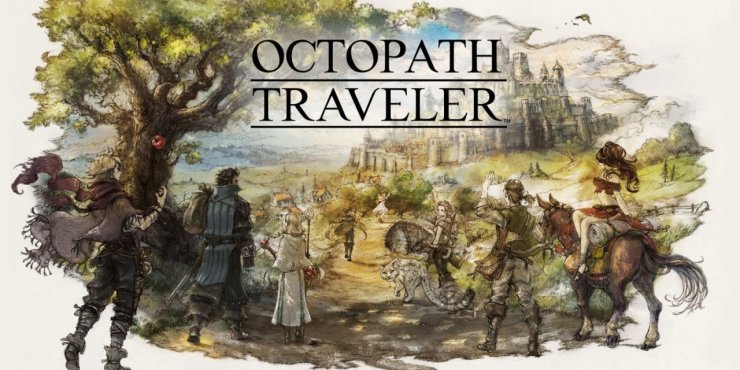
Image Credits: Nintendo

